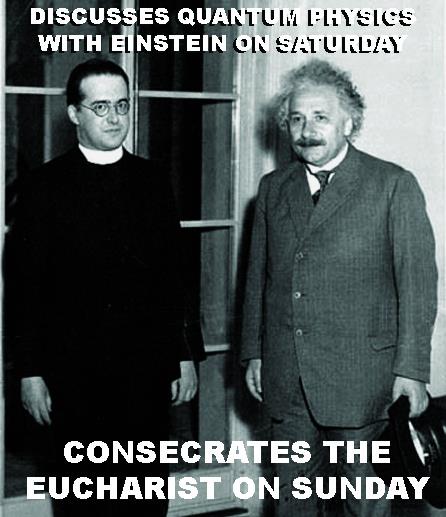
and how many men of the cloth since then have been science leaders again?
tons actually
A
Nicolaus Copernicus
Roger Bacon's circular diagrams relating to the scientific study of optics
Monsignor Georges Lemaître, priest and scientist
Gregor Mendel, Augustinian monk and geneticist
Sacrobosco's De sphaera mundi
Marin Mersenne
Pierre Gassendi
William of Ockham
Illustration from Steno's 1667 paper comparing the teeth of a shark head with a fossil tooth
Nicole Oresme
Albertus Magnus
Christopher Clavius
First page of Boscovich's Theoria Philosophiæ Naturalis
Map of the Far East by Matteo Ricci in 1602
Nicolas of Cusa
Statue of Roger Bacon in the Oxford University Museum
Nicolas Steno
machina meteorologic invented by Václav Prokop Diviš worked like lightning rod
Athanasius Kircher
Medieval depiction of a spherical earth
Roger Boscovich
Robert Grosseteste Lorenzo Albacete (1941) Priest physicist and theologian José de Acosta (1539–1600) – Jesuit missionary and naturalist who wrote one of the very first detailed and realistic descriptions of the new world François d'Aguilon (1567–1617) – Belgian Jesuit mathematician, physicist, and architect. Albert of Saxony (philosopher) (c. 1320–1390) – German bishop known for his contributions to logic and physics; with Buridan he helped develop the theory that was a precursor to the modern theory of inertia[6> Albertus Magnus (c. 1206–1280) – Dominican friar and Bishop of Regensberg who has been described as "one of the most famous precursors of modern science in the High Middle Ages."[7> Patron saint of natural sciences; Works in physics, logic, metaphysics, biology, and psychology. Giulio Alenio (1582-1649) - Jesuit theologian, astronomer and mathematician.
these are just scientist-clerics, not referencing catholic lay scientists
The question was how many men of the cloth have been leaders in science since then (40's-50's)?
Not going back to the 1400's.
-This message has been edited by DCPhoto on 1/28/2013 10:04:59 AM
i just cut and pasted from wiki
i dont have time to sort through all those for you, i gave you the link
So in other words, you don't know. You just look over a wikipedia entries and pretend to know things.
Can't just say there's been "three" leaders with discoveries in ________ and _______ .
right
are you coming at my memorization skills
because it seems to be that true wisdom and intelligence involves knowing where to find the answer, not memorizing everything like a fucking parlor game
You would have an actual answer if I were wrong.
what? i just agreed with you
of course i dont have every catholic clergyman/scientist memorized
why would i?
de_la_mierda quote:are you coming at my memorization skills
because it seems to be that true wisdom and intelligence involves knowing where to find the answer, not memorizing everything like a fucking parlor game
I think having a rough estimate number is perfectly normal thing.
I only came up with 24. That was being generous with a lot of them dieing in their 70's and beyond in the 40's. Many of which aren't of particular note, just being jesuit and "scientists" not all of them are leaders or visionairies. Of the 24 since Georges Lemaître, only 9 are alive today.
9 living "scientists" on your link, doesn't make the church a bastion of scientific discovery, which seems to be the implied schtick you've been playing in this thread and others. On the other hand, I get the point that those that bash the church and the right wing often say that both are against science, which this proves an exception, while not being a reflection of the majority still a fact nonethelss.
de_la_mierda quote:what? i just agreed with you
of course i dont have every catholic clergyman/scientist memorized
why would i?
The answer is around a couple dozen with less than a dozen alive.